


When it comes to business, your internet is not just a utility. It is the foundation your operation runs on. Once everything goes down, work stops. Team members cannot work, clients cannot reach you, and every minute that passes starts to cost you. Many businesses only realize this after an outage, when they discover their provider's so-called guarantee was just a sales promise and not a written commitment.
This is exactly what a Service Level Agreement, or SLA for short, is designed to avoid.
What Is an SLA?
A Service Level Agreement is a legally binding document that sets expectations between parties. It is an enforceable commitment from your internet provider that specifies the reliability of your connection and outlines the process and remedies if the provider falls short of these standards.
At Cygnal, we commit to 99.5% uptime. That means your connection is guaranteed to be available 99.5% of the time each month. Not "most of the time." Not "we'll do our best." A specific number, in writing, that we are held to.
What the Numbers Actually Mean
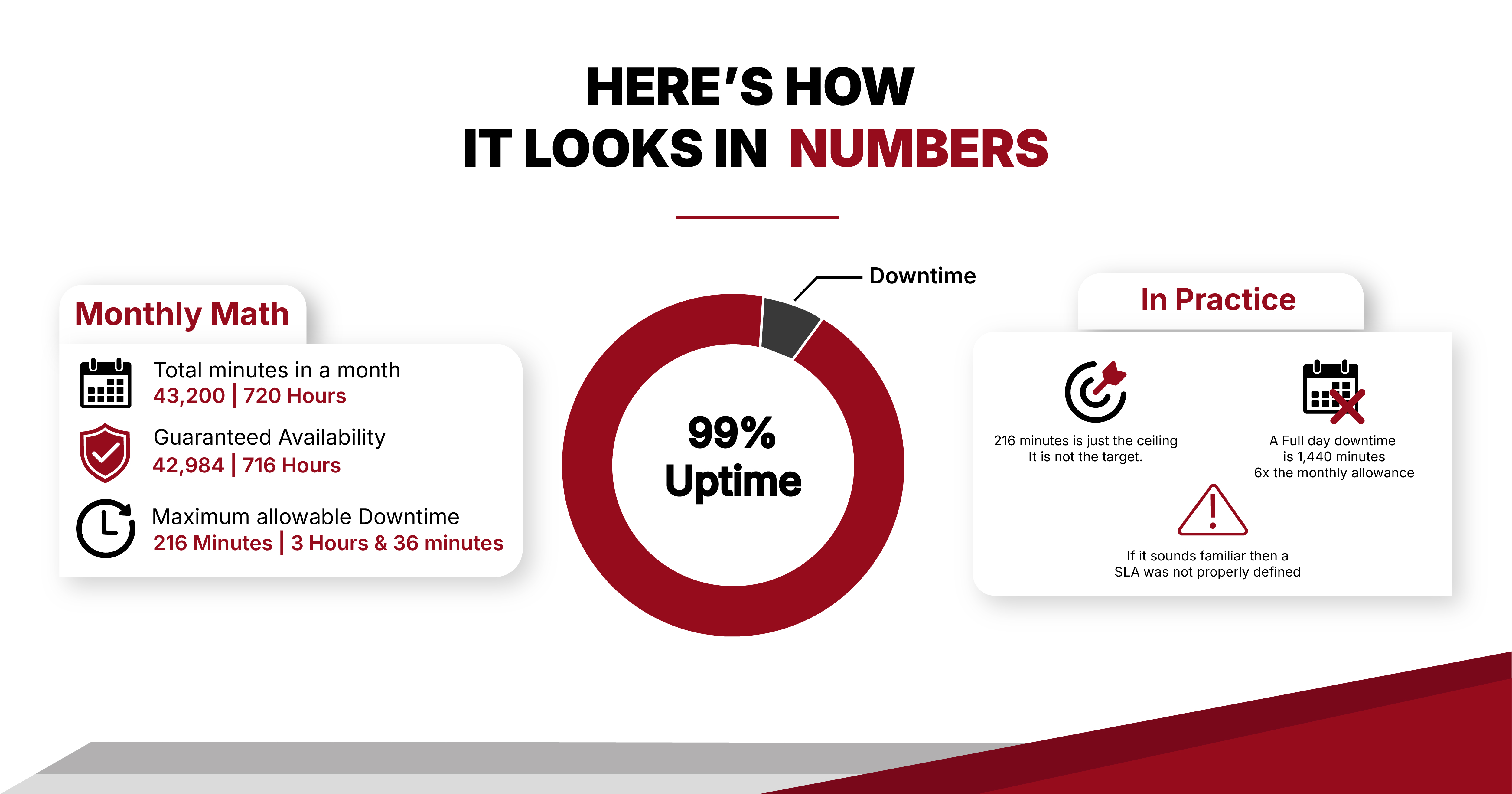
99.5% may sound close to 100%, but in practice it defines a very specific ceiling on how much downtime your provider can have before breaching the agreement.
What Is Covered and What Isn't
A good SLA is clear about what counts as downtime and what does not. SLAs typically cover an overview, service description, a breakdown of the parties involved, and metrics such as uptime, response time, quality indicators, and resolution time. Without these metrics, there is nothing to measure and nothing to enforce.
Covered under our SLA
- Equipment failures on our side
- Power interruptions affecting our network facilities
- Any unplanned outage within our infrastructure
Not counted as downtime
- Scheduled maintenance, announced in advance
- Power outages at your location
- Equipment you own — routers, switches, Wi-Fi devices
- Issues within your internal network
- Natural disasters and force majeure events
If your office loses power and your connection drops, that is not on us. But if our infrastructure goes down and takes your connection with it, that counts, and we are accountable for it. SLA terms also vary by business type in their exclusions, protocols, and indemnification clauses.
What an SLA Is Actually Made Of
An SLA is not just a number on a contract. The uptime percentage is the part people remember, but it is only one piece of what a complete service level agreement should contain.
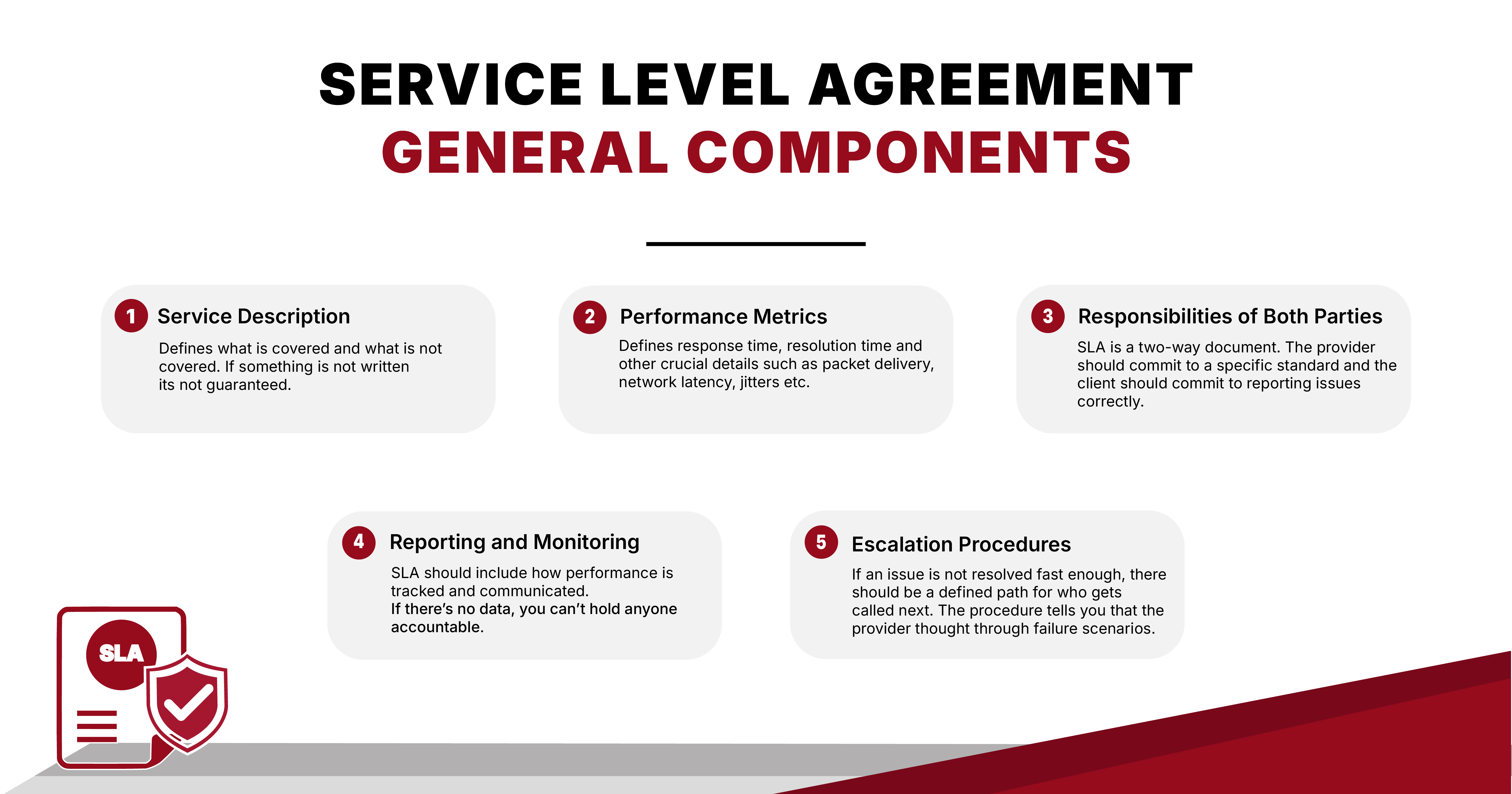
- Service Description — defines exactly what is covered and what is not. If it is not written down, it is not guaranteed.
- Performance Metrics — goes beyond uptime. Includes response time, resolution time, packet delivery ratios, network latency, and jitter.
- Responsibilities of Both Parties — the provider commits to service standards; the client commits to reporting issues correctly and following agreed procedures.
- Reporting and Monitoring — how performance is tracked and communicated. If you cannot see the data, you cannot hold anyone accountable.
- Escalation Procedures — a defined path for who gets called next when first-level support is not resolving the issue fast enough.
Severity Levels and Why They Matter
A complete SLA does not treat all incidents the same. Issues are categorized by severity, and that category determines how fast the provider is required to respond. Understanding these tiers tells you a lot about whether a provider takes accountability seriously.
Critical — S1
- Complete service outage
- Full business impact
- Immediate response required
- All hands engaged until resolved
High — S2
- Major performance degradation
- Significant but partial impact
- Response within the hour
- Senior engineer assigned
Medium — S3
- Minor disruption or intermittent issue
- Limited operational impact
- Response within a few hours
Low — S4
- Informational or cosmetic issue
- No immediate business impact
- Addressed within 24 hours
If your provider's SLA does not distinguish between a complete outage and a minor issue, that is worth asking about. The response time commitment for a full-down S1 incident should look very different from an S4 inquiry.
Red Flags to Watch For Before You Sign
Not all SLAs are written with the client's best interests in mind. Some are designed to look comprehensive while leaving the provider plenty of room to underdeliver. Before signing, check for these:
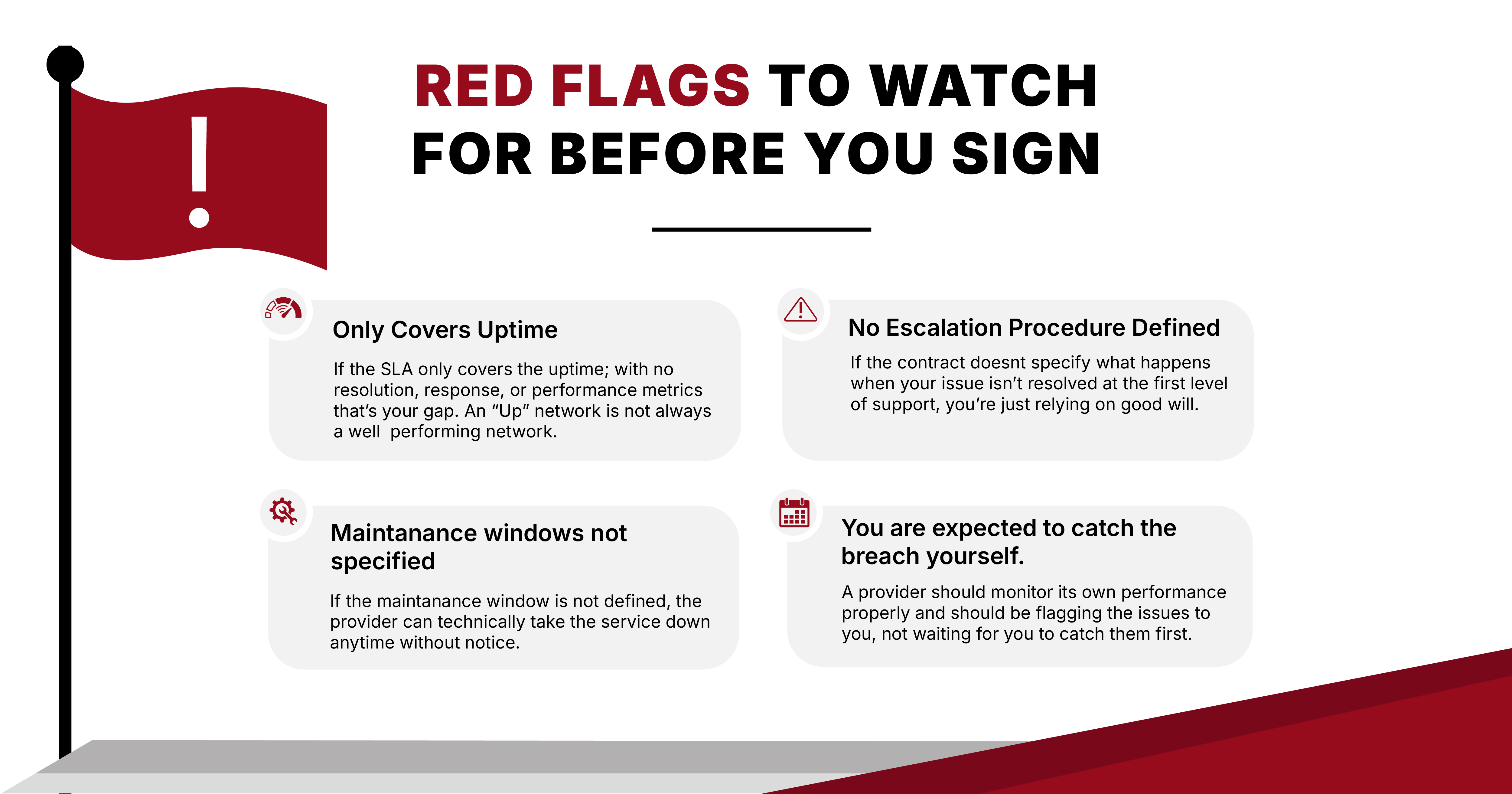
- Only covers uptime. No response time, resolution time, or performance metrics means your connection can be technically "up" and still performing poorly with no recourse.
- No escalation procedure defined. If there is no defined path for when first-level support fails you, you are relying on goodwill — not a commitment.
- Maintenance windows not specified. Without defined windows, the provider can technically take your service down at any time without violating the SLA.
- You are expected to catch the breach yourself. A provider monitoring its own performance should be flagging issues to you — not waiting for you to notice first.
Why This Matters for Your Business
Downtime is not just an isolated IT problem. It is a business problem.
For BPO firms and call centers across Mindanao and Visayas, every minute the floor is offline is a minute agents cannot work. Multiply that by headcount and the numbers become significant. A single unplanned outage can mean missed call targets, breached client contracts, and penalty clauses you are now on the hook for.
For network-dependent operations, the domino effect goes further. Your clients have their own commitments to meet, and when your connection goes down, their operations slow down too. That is your reputation on the line, not just your provider's.
When your provider does not have a written SLA, there is no floor, no accountability, and no recourse when things go wrong. A written service guarantee does not just protect your uptime. It protects your business. It tells you exactly what your provider is willing to stand behind, and that is information worth having before you sign anything.
How Cygnal Manages It
Meeting a 99.5% uptime commitment requires proactive effort, not reactive fixes. Here is what we do:
Our operational commitments
- Continuous monitoring. We use network monitoring tools to track performance around the clock. As a provider, we are usually aware of an issue before you are. Once we spot something, we are already investigating it.
- Swift response times. When issues are reported during business hours, engineers are already observing the line and move quickly to resolve them. For clients with active monitoring, feedback becomes immediate.
- Direct access to engineers who know your setup. When an issue occurs, you speak directly to the engineer managing your connection, not a general support queue. The person you reach already understands your network.
- Advance notice for scheduled maintenance. When maintenance is necessary, we give advance notice, typically a month or more. It never counts against your SLA and is always communicated clearly before it happens.
If downtime exceeds your monthly SLA allowance, the difference is credited to your next bill. The commitment is in writing, and so is the accountability.
Every SLA Is Different — And That's the Point
What this article covers is a foundation. The components, the metrics, the red flags — these are the things every business should understand before sitting down to discuss a service agreement. But no two SLAs are identical, and they should not be.
A BPO handling international clients on overnight shifts has different uptime requirements than a local office that operates Monday to Friday. A business running real-time financial transactions needs stricter latency and packet loss commitments than one using the connection primarily for email and cloud storage. The severity levels, response times, remedies, and exclusions in a well-written SLA should reflect the actual operational reality of the client — not a generic template.
This is especially true in B2B connectivity. What is outlined here is the general framework. The specifics — what gets covered, what the numbers actually commit to, and what happens when something goes wrong — are a conversation, not a fixed document handed across a table. If you want to understand what an SLA for your specific situation should look like, that is where talking to your provider directly matters more than any article.
Bottom Line
Understanding what a Service Level Agreement actually means is one of the most important things a business can do before choosing an internet provider. Not all SLAs are equal. What matters is whether the uptime percentage is specific, whether downtime is clearly defined, and whether there is an actual remedy when the provider falls short.
If you are evaluating a new connection, our guides on dedicated internet access and how to choose a business internet provider in the Philippines cover what to look for before signing anything.